

Transport · BTP · Agriculture · Professional floats
Private investigator for fuel theft investigations
Investigate unexplained fuel losses, unusual stops and vehicle use. INVESTIPOLE plans targeted checks around tanks, access points and fleet movements.
Controlled budget. Fleet data is used to target specific time windows, never to organise constant surveillance.
Theft of fuel in company
Overconsumption alerts, without proving theft.
Diesel theft affects fleets of lorries and commercial vehicles, construction machinery, agricultural equipment and storage tanks. The methods vary: siphoning from a tank or a GNR tank, filling up jerry cans, fuel card used for a personal vehicle, resale to third parties.
Relief, load, idle, cold, driving, failure, input error or poorly calibrated tank also explain a deviation. The investigation becomes useful when anomalies occur around a vehicle, card, driver, station or niche.
For nearly 20 years, Investipole has been investigating corporate fraud, including fuel theft. All your detectives have at least 10 years of experience. The mission aims to document the operation that explains the discrepancy; failing that, the report specifies whether the hypothesis of theft can be ruled out for the examined periods.
Fleet indicators
What fuel discrepancies warrant a check?
An anomaly beam reduces the scope of the investigation and avoids unnecessary observation hours.
Inconsistent volumes
Full excess of useful capacity, close purchases, litres unrelated to the kilometers, off-tour refuelling.
To isolate: card, vehicle, station, date and volume.
Repetitive pattern
Operations on the same day, at the end of service, during breaks, before returning to the depot or in a recurring station.
To isolate: sequence and frequency over several weeks.
Conflicting data
Invoice without travel, card used during vehicle immobilization, rounded mileage, ticket attached to the wrong gear, tank that drops on weekends.
To isolate: available parts and possible technical explanations.
Procedures
Fuel theft isn’t just about siphoning.
Each mechanism leaves different traces: in the data, in the field or in accounting.
Siphoning and jerrycans
Tank, storage tank or empty equipment at manual pump, fuel transferred into jerricans, then carried away.
Misused fuel card
Card loaned, code shared, full for a personal vehicle, multiple purchases or shop products paid out of the rules.
Using the vehicle for personal purposes
Repeated non-activity journeys or consumption borne by the employer for use outside the contract.
Organised resale
Regular sampling, intermediate storage, appointment and delivery of diesel or GNR to several buyers.
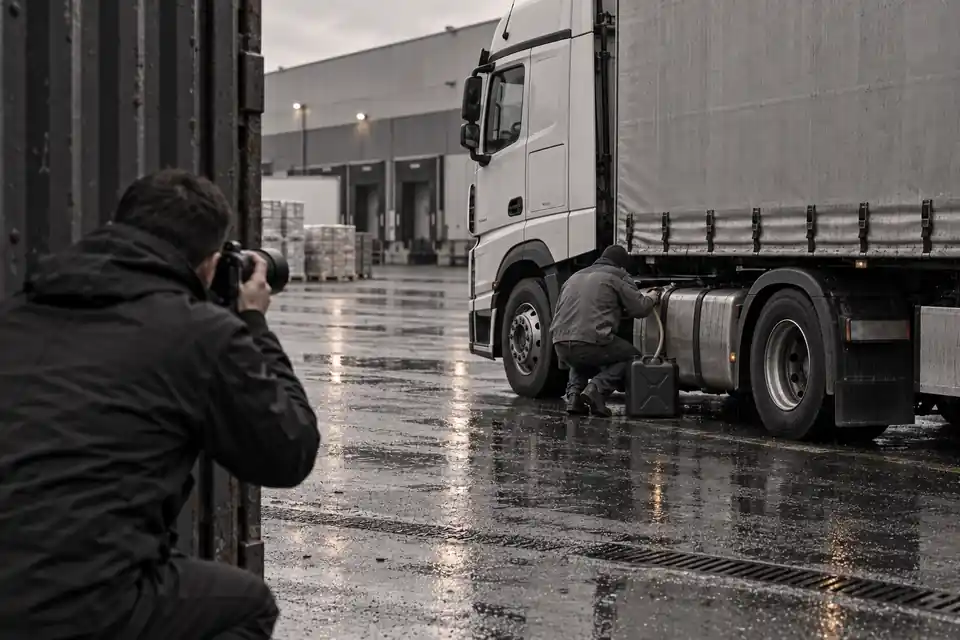
Photo of illustration: refuelling a vehicle at the pump.
Observe full operation
A pump stop doesn’t show where the fuel goes.
Your detectives document the vehicle present, the pump, the containers, the duration and, if it remains useful and proportionate, the movements that follow the purchase. Remission or use of fuel is noted when the scene remains visible from public space.
The purchased litres are read on an invoice; the diverted litres are seen in the field.
No confrontation on the spot, no transaction initiated.
Data-driven investigation
Reduce the gap, target the time windows, note the action
A few hours of analysis often avoid several unnecessary days of surveillance.
Map the fleet
Vehicles, tanks, equipment, vats, cards, drivers, tourings, stations and usage rules are combined in an operational reading.
Compare the indicators
Liters, kilometers, load, engine hours, tickets, tank levels and technical constraints bring out the truly atypical sequences.
Watch the useful time windows
discreet surveillance and surveillance are concentrated on the station, depot, yard or shed designated by the analysis.
Bring together and report
The report describes the visible operations. The company crosses them with its data; his lawyer appreciates the qualification, complaint and social follow-up.
Fuel theft: penalties, serious offence and proof
Reveal the anomaly
Volume, frequency, vehicle, map and station show an inconsistency to explain.
Shows the operation
Pump used, container, beneficiary, route and repetition, seen from public space.
Sheds light on the qualification
Theft, abuse of trust, disciplinary misconduct or simple error: the lawyer then, if necessary, the judge retains the qualification in view of the complete file.
Cases processed
Diesel and fuel theft: four investigations
Volumes, trades and conclusions are simplified to preserve confidentiality.
Maintenance · Daily siphoning
Cans filled during lunch break
A company reports a recurring decline in the level of a utility, while its kilometres remain stable. Key delivery and break schedules are defined as a specific niche.
A limited observation shows the opening of the tank, the filling of cans, and then the transport of these cans to a personal vehicle. The sequence is photographed from public space and checked on a second niche, so as not to conclude from an isolated gesture.
The report is read in conjunction with the fuel records and vehicle use rules. The employer then consults his lawyer to quantify the damage, collect explanations and select a proportionate response.
Transport · Organised resale
Several drivers pump into a parallel system
A transport company finds a gap of close to 30% between expected consumption and purchases. The analysis isolates the full closeness around the same station, at the end of the tour.
Coordinated monitoring documents the filling of containers, temporary storage, and the delivery of fuel to third parties. The report distinguishes drivers, vehicles, visible volumes, places and times, without stating what the images do not allow to be measured.
Management brings these observations closer to maps, invoices and mileages. The lawyer separates individual responsibilities and prepares the procedures with the competent authorities.
Commercial fleet · Fuel card
Fill-ups for a private vehicle, on weekends
The records of a fuel card show purchases on certain weekends, while the company vehicle remains immobilized. A targeted observation, at the station identified, notes the use of the card to power a personal vehicle.
A second similar operation is noted a few days later. No hidden geolocation is used, and private movements are followed only to the extent strictly necessary for the finding.
The company verifies the allocation of the card, its conditions of use and any authorisations before any decision is taken. The automatic reconciliation between card, registration, mileage and vehicle present at the pump is also reinforced.
Public Works · Anomaly explained
The excessive consumption came from a vehicle, not from theft
A driver is suspected after several fuel consumption exceedances on a site. The study of capacity, engine hours and idle operation shows that kilometres are not an appropriate indicator for this equipment.
The observations do not reveal any cans, third-party vehicles or abnormal outlets. A technician then identifies a defect and prolonged use of hydraulic equipment.
The report excludes the theft hypothesis on the time windows examined and explains the limitations of the initial comparison. The company avoids a fragile charge and adapts its tracking by type of gear, load and engine hours.
Related files
Fuel often hides a bigger fraud
A fuel gap sometimes accompanies misuse of the vehicle, a hijacked card, goods or equipment that disappear.
Road axes and relays
The trucks keep moving. The investigation continues without interruption.
A tour can cross several departments, change drivers and multiply stations. Investipole organizes field relays to maintain continuity without multiplying the point of contact.
The report consolidates the useful sequences for fleet management, HR managers and counsel.
Fleet managers' questions
Fuel theft: frequently asked questions
General replies combining fleet control, employee rights and proportionate evidence.
How to detect fuel theft in a business?
By comparing the purchased litres, tank capacity, kilometres, engine hours, load, stations and history. A repeated anomaly around a map, vehicle or niche can then be used to target a check.
Overconsumption and siphoning: what's the difference?
An overconsumption is a figure; siphoning is a gesture. Panne, slow down, relief, cold, charge or error of input also explain a deviation. A material sequence, found and dated, gives the suspicion of theft a factual basis.
Can fuel card data be used?
Yes, in keeping with the purpose of processing, employee information and shelf life. These records are used to detect anomaly, then close to tours, kilometres and findings.
Diesel theft from a truck or tank: how to protect against it?
Anti-siphon plugs and studs, park lighting and fences, level alarms, locked tanks, individual code cards and vehicle ceilings reduce the risk. On fixed vats, connected gauges report an abnormal drop outside of hours of activity.
GNR theft on a site or a farm: what should you do?
To raise the levels of tanks and equipment before and after each period of inactivity, to secure the vats and to file a complaint as soon as a sample is found, reporting any break-in. If samples persist, targeted monitoring of the site at night or on weekends can document the operation and its beneficiaries.
Fuel theft and insurance: what coverage is available?
Coverage depends on your policy. Ask your insurer whether stolen fuel and damage to the tank or filler cap are covered, and which evidence it requires. Keep your complaint record and available fuel measurements.
Tracking a lorry across several counties: is it possible?
Yes, where this continuity is useful, legal and proportionate to the written agreement. Field relays preserve discretion and control travel times.
Diverted volumes: what can the report determine?
The report describes the containers, operations and visible volumes where a reasonable estimate is possible. Final encryption is based on invoices, capacities and technical data; no missing measures are invented.
theft observed during the mission: what reaction?
Investipole informs the client according to the agreed protocol. Your detectives do not call anyone and search any vehicle; an intervention of the law enforcement authorities is the sole decision of them.
How much does a fuel theft investigation cost?
The pricing of a private detective in a fuel theft case ranges from €90 to €120 excluding VAT per hour depending on several criteria, with a free quote. For guidance: approximately €975 excluding VAT per day, €4,750 excluding VAT for an all-inclusive five-day package. Details on the cost of a private detectiveFR.
Confidential analysis
Inconsistent records? Show them.
Prepare vehicles, cards, volumes, kilometres, stations, schedules and usage rules. Investipole evaluates feasibility and estimates only the useful means. Write to contact@investipole.fr.
Analyze anomalies free quotation · Targeted intervention · Confidentiality